← Work

Case study · compliance eLearning

IT General Controls Global eLearning

I designed and developed a self-paced course that translated technical IT control requirements into practical explanations, workplace examples, and guidance on employee responsibilities.

Instructional designTechnical content translationSME collaborationStorylineCompliance learning
Download PDF case study
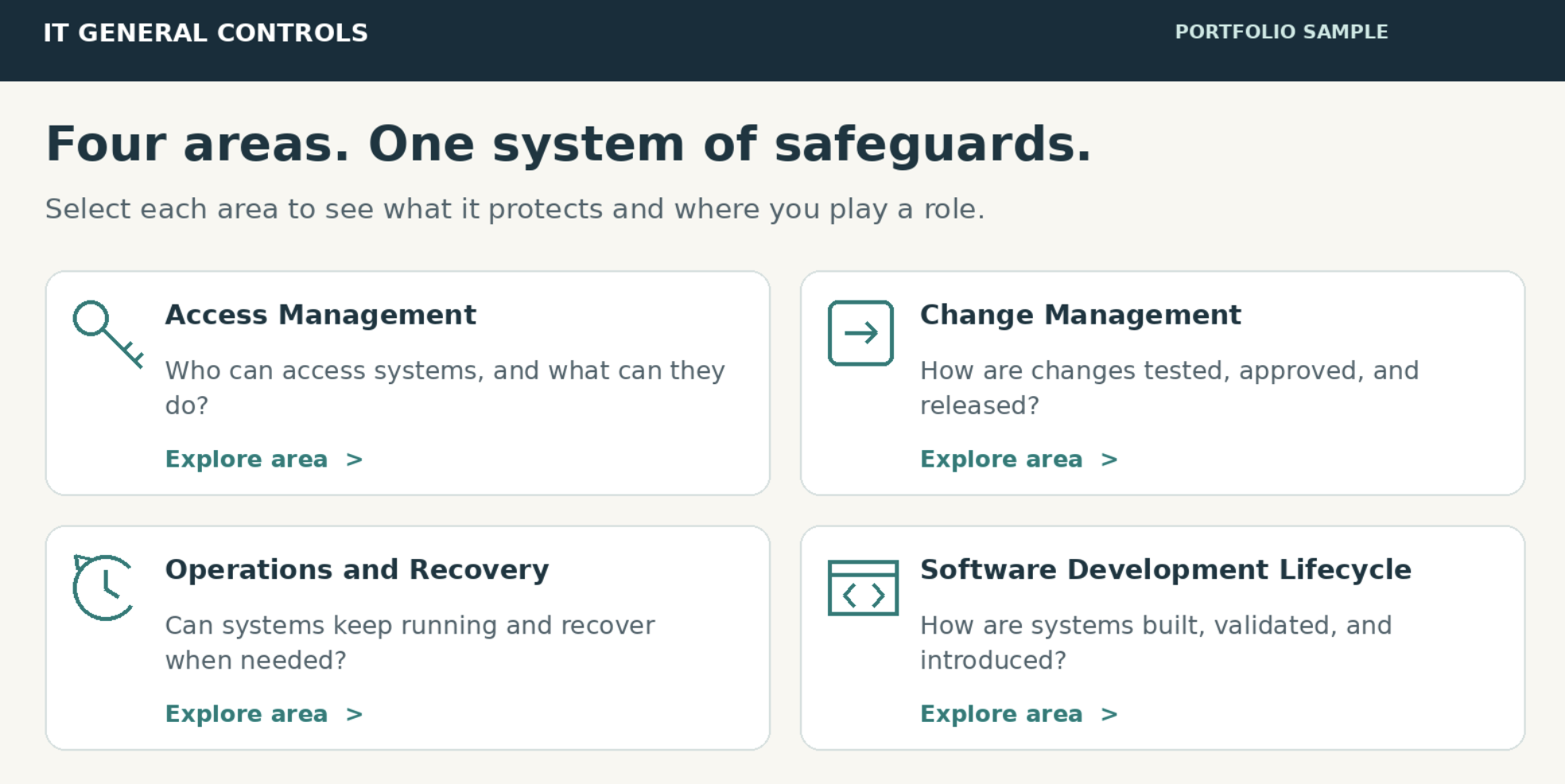
IT General Controls course navigation showing four control areas
AudienceIT employees and relevant contractors
RoleInstructional Designer and Developer
ToolArticulate Storyline
FocusIT General Controls, SOX compliance, and audit readiness

The challenge

Preserve the accuracy. Reduce the effort to apply it.

Employees needed to understand how IT General Controls supported reliable systems and financial reporting, and where their own responsibilities began. The source material included formal control statements, audit expectations, and process documentation.

The learning needed to preserve that technical and compliance accuracy while making the requirements easier to interpret and apply.

My role and approach

Shape technical source material into an engaging and memorable learning experience.

I partnered with an IT subject matter expert to organize the technical content and shape the learning experience. My work included writing learner-facing explanations and narration, storyboarding, designing interactions and examples, and developing the original course in Articulate Storyline.

The course focused on understanding controls and recognizing responsibilities. Detailed procedures and control documentation remained available through supporting resources.

Memorable learning anchorRight Person. Right Access. Right Time.
01

Translate complexity

I identified the essential behavior behind each control requirement. For Access Management, authorization, least privilege, access reviews, and timely removal of permissions became a memorable anchor: Right Person. Right Access. Right Time.

02

Connect controls to consequences

I used examples of control failures to explain why the requirements mattered. Unnecessary production access could enable an unauthorized change. An untested backup could leave a team unable to restore data.

03

Build ownership

The course established that people who manage systems, develop applications, approve access, or oversee operations all play a role in maintaining controls and evidence.

Making the control areas memorable

Use a shared mental model, then make the risk concrete.

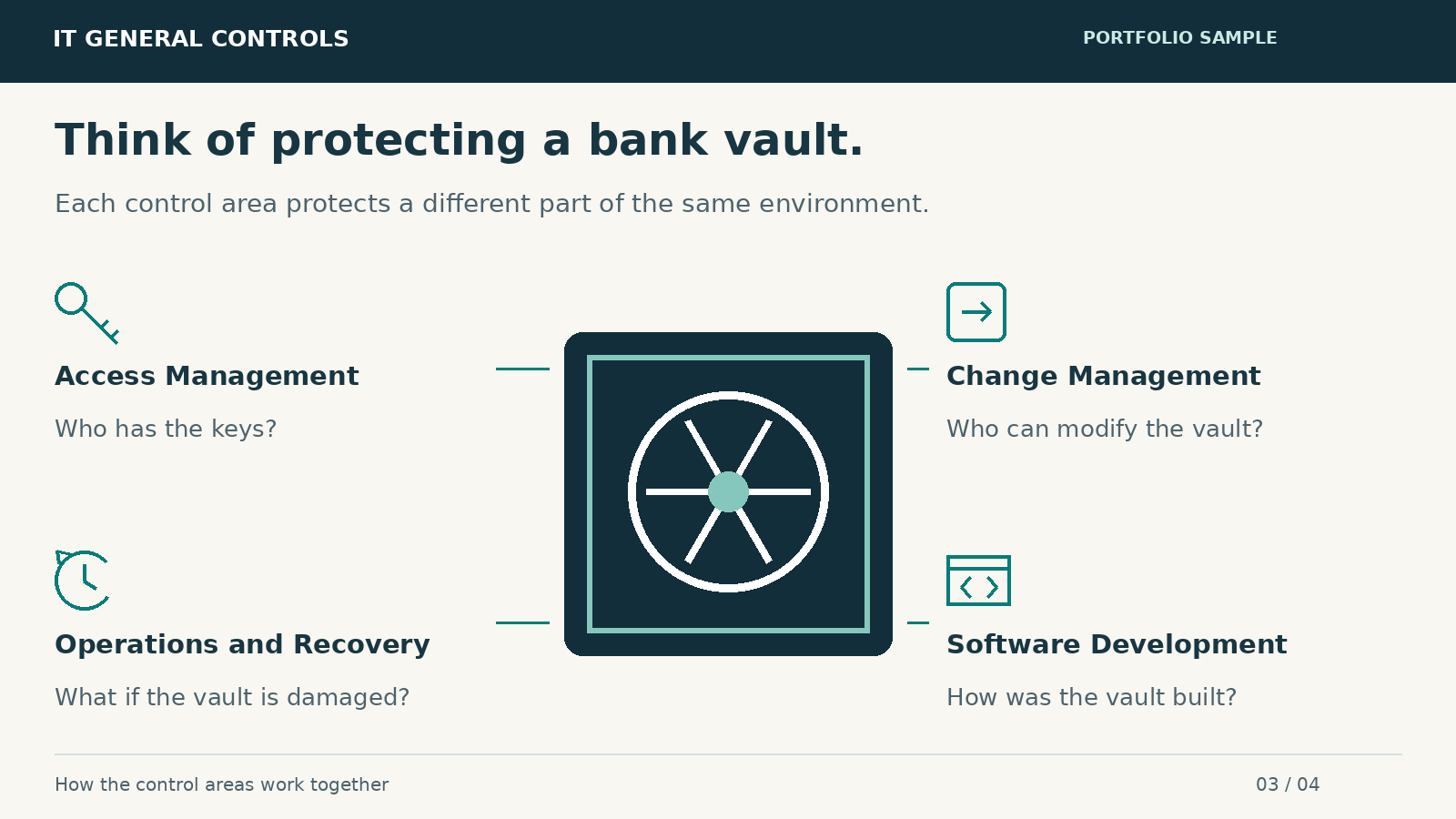
The bank-vault analogy in the original storyboard gave learners a shared mental model for the four control areas. Each question explained a different responsibility within the same protected environment.

Interaction with a clear purpose

The four-area exploration gave the content a manageable structure. Requiring each area to be explored ensured coverage of the major topics. The interaction supported navigation and organization; it did not, by itself, demonstrate understanding.

Examples that reveal risk

The original content paired each control area with a failure example. For recovery, regular backups had never been tested. After a system failure, the data could not be restored. That example made the difference between having a backup and being able to recover concrete.

Recreated bank vault analogy for IT control areas
Recreated analogy screen based on the original storyboard.

The result

One structured learning experience connecting controls, consequences, responsibilities, and support.

I completed the Storyline course and uploaded it to the organization’s learning management system. Assignment was awaiting final audience information when I left, so post-launch completion data, learner feedback, and performance measures were not available to me.

The deliverable brought the four control areas, practical failure examples, employee responsibilities, and supporting resources into one structured learning experience. This case study demonstrates the design and development work and makes no claim of measured improvement in compliance or audit outcomes.

Instructional designTechnical content translationSME collaborationStoryboardingArticulate StorylineCompliance learningInteraction & feedback design
Portfolio note: Portfolio visuals are recreated and anonymized from the original storyboard. The scenario and feedback are new examples developed for this portfolio.