← Work

Case study · sales enablement

National Consultative Sales Program

I created and managed a national learning program to help underwriters strengthen broker relationships and apply consultative sales skills. My work included needs analysis, vendor selection, instructional design, and trainer support, with reinforcement and evaluation extending beyond the classroom.

Needs analysisProgram managementTrain-the-trainerBlended learningEvaluation
Download PDF case study
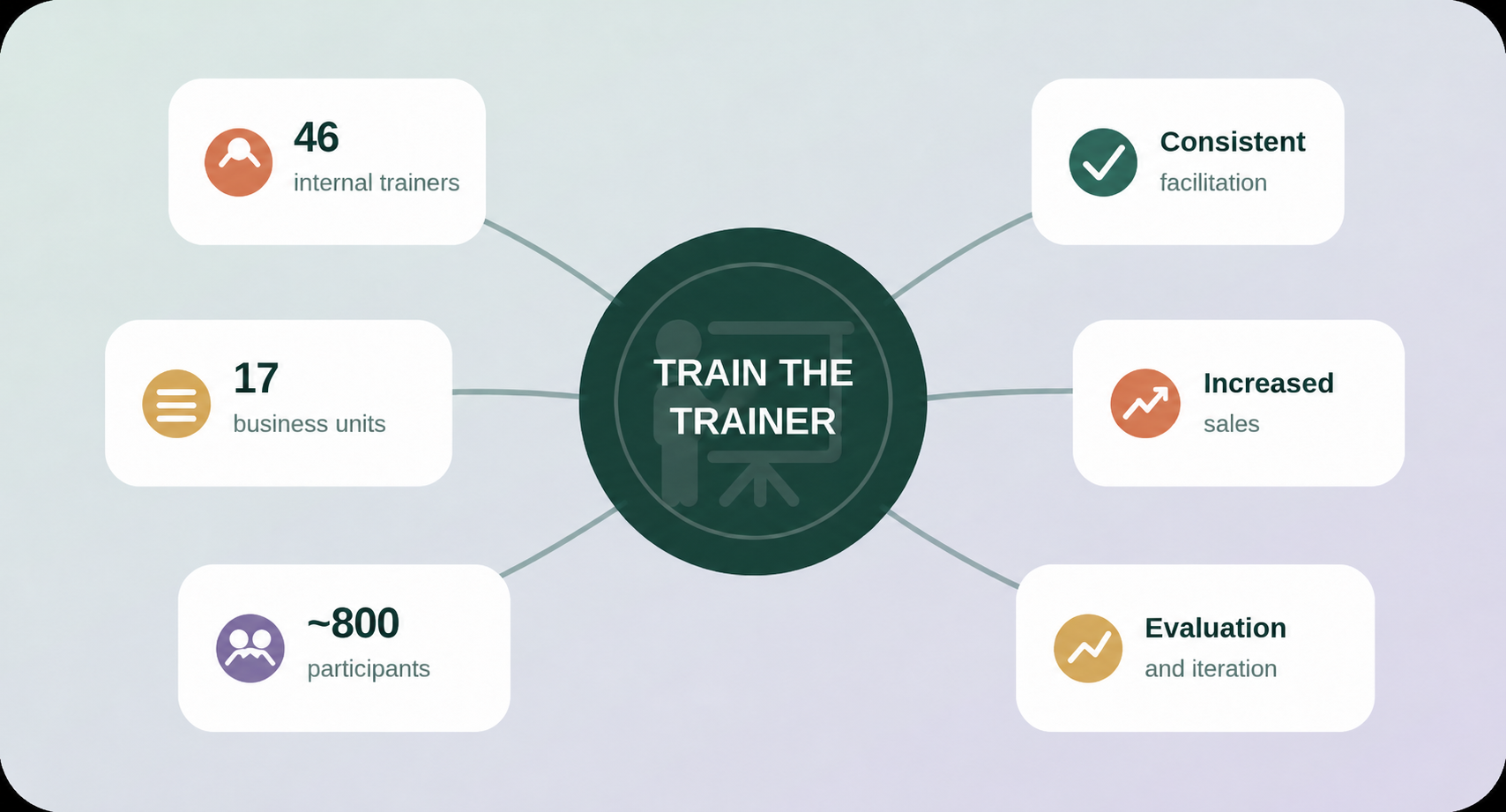
Visual summary of the national sales train-the-trainer program
~800participants
46internal trainers
17business units
3 yearsprogram growth

The challenge

Build consultative sales capability in a relationship-focused culture.

An insurance organization without a traditional direct sales function needed to build the consultative sales capabilities of its underwriting teams. Some leaders approached broker relationships primarily from a technical service mindset and needed support to see the value of a more consultative approach.

The program had to fit the company culture and work across business units, product lines, and locations. It needed a shared learning structure with room for teams to adapt examples and application to their own products.

Needs analysis and vendor selection

Find the right expertise, then make the solution belong to the organization.

I partnered with the Director of Marketing to assess the need and first explored internal subject-matter expertise. With no internal sales function to draw on, I researched external providers and identified four potential vendors. The project team considered budget, customization, and fit with the company’s values and broker relationships.

We selected a boutique training firm that agreed to company ownership of the content and an internal train-the-trainer model. This gave business units flexibility to teach the material in ways that fit their teams and helped build internal support for the program.

How the program worked

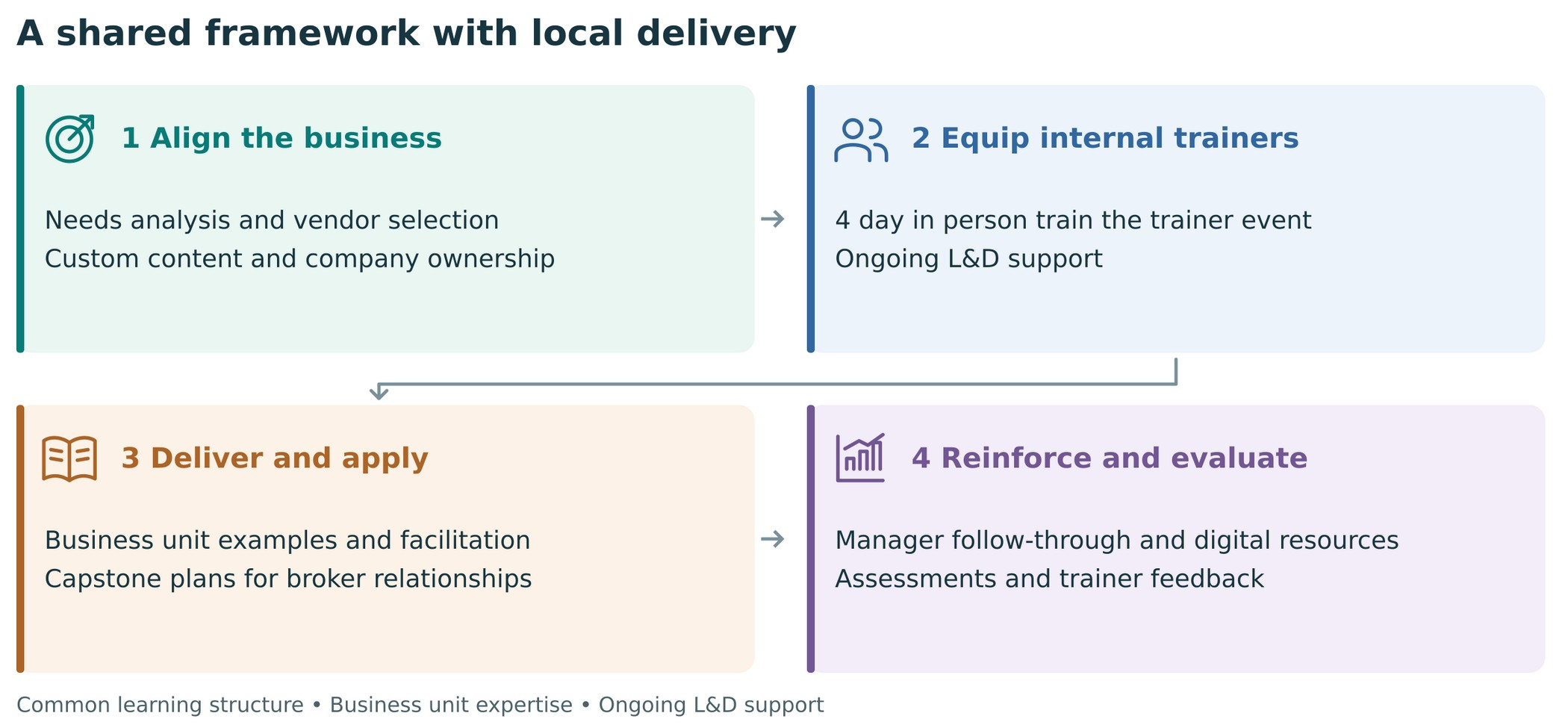
A shared framework with local delivery.

An external master trainer prepared internal trainers, who delivered the program within their business units. L&D provided consultation, learning resources, event coordination, assessment support, and ongoing trainer guidance.

Four-part framework showing alignment, trainer enablement, delivery, and evaluation

Implementation

Make local delivery practical, repeatable, and connected to the work.

01

Prepare trainers for local delivery

I recommended at least two trainers per business unit so facilitators had a partner during delivery. Preparation included formal training, practice, coaching, facilitator resources, content-review meetings, and rehearsals covering timing, activities, co-facilitation, and local examples.

02

Manage implementation across business units

As program manager, I was the central contact for the vendor, project team, 46 trainers, L&D, and operational leadership. I coordinated implementation across 17 business units and designed eLearning resources, logistics guidance, communications, learner materials, and event workflows.

03

Connect learning to everyday work

A capstone asked participants to identify broker relationships, plan how to apply the tools, and discuss accountability with managers. Coaching, recap videos, worksheets, manager guidance, and follow-up assessment supported continued application.
Evaluation and improvement

Use feedback to change the support system, not just the course.

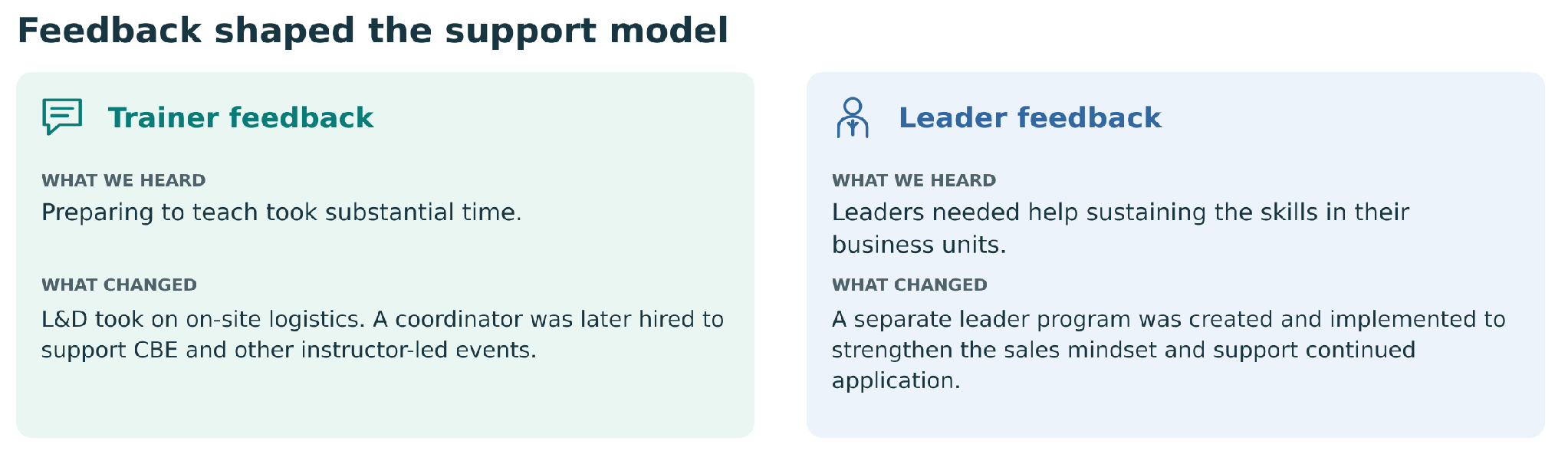
Pre- and post-training 180-degree assessments incorporated learner and manager perspectives. Surveys, trainer observations, and capstone discussions helped identify areas for reinforcement. I also hosted post-training meetings with trainers to understand what was working and where support needed to improve.

Those insights changed how the program was supported as implementation continued.

Feedback graphic showing changes made from trainer and leader feedback
Trainer feedback led L&D to take on more event logistics. Leader feedback informed a separate leader program focused on sustaining the sales mindset.

The result

A program that scaled through internal experts without becoming generic.

Over three years, the program reached approximately 800 participants through 46 trainers across 17 business units. The train-the-trainer model expanded delivery through internal experts while maintaining a shared learning structure and ongoing L&D support.

The program grew to include executive-leader learning, eLearning, and video resources. It gave underwriters a common approach for consultative conversations, building broker relationships, and identifying sales opportunities.

Needs AnalysisProgram ManagementTrain-the-TrainerInstructional DesignVendor PartnershipStakeholder ManagementBlended LearningLearning Evaluation

Portfolio note: Original program materials are owned by my previous employer and are not reproduced here. The graphics were created for this portfolio. This case study describes my contributions and the program’s scope.